Team Communication Across Time Zones
Slack & Internal Coordination
International teams operate asynchronously.
Expecting real-time alignment across time zones is one way to create burnout, missed decisions, and operational blind spots all in one go.
Yet a lead business may mistakenly structure communication as if everyone is working the same hours, in the same room, with instant access to context.
And that assumption usually breaks the moment you need to scale internationally.
In global lead operations, communication is core infrastructure.
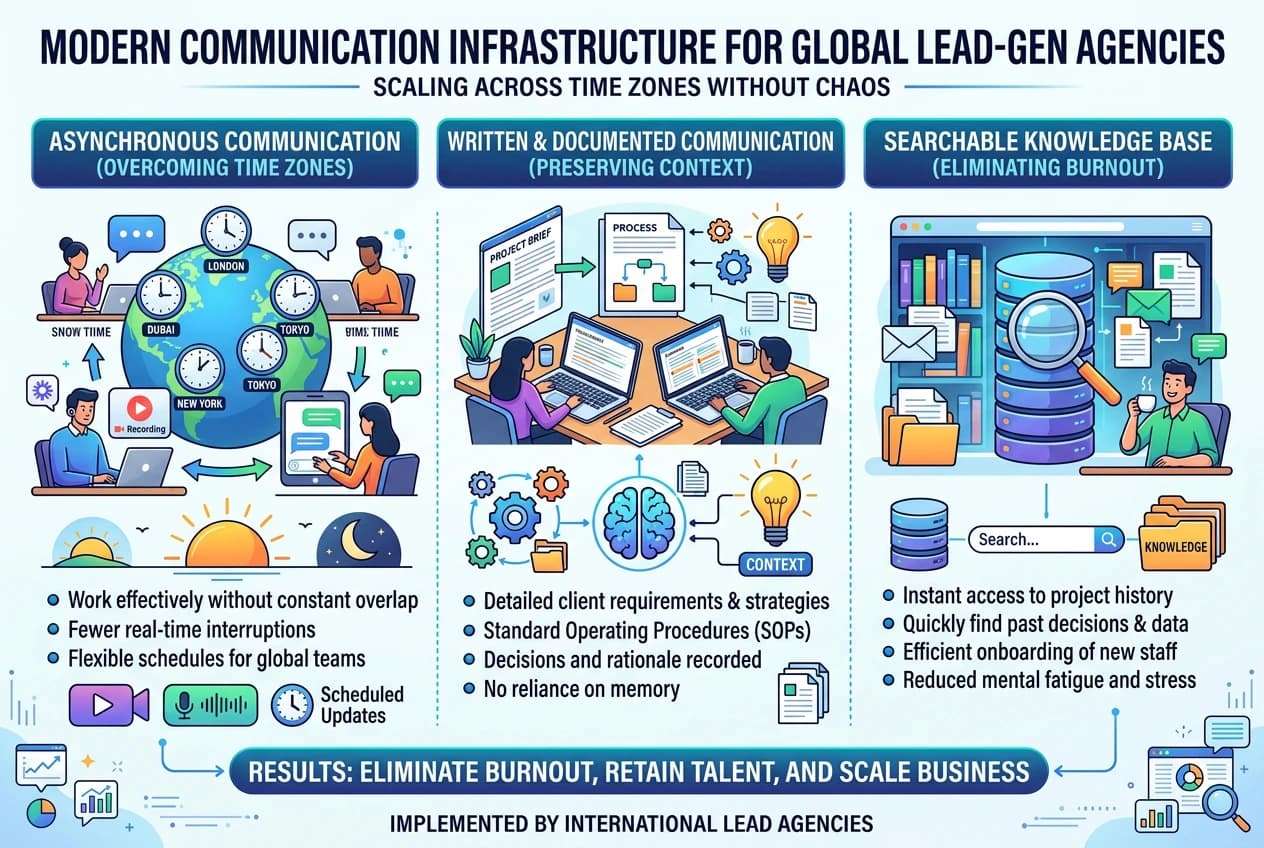
Real Time Communications - an important subject when going international
Real-time communication depends on ‘overlap’ which international teams rarely do. Common failure points include:
- People working around the clock - asynchronous communication
- Context lost between shifts - for big agencies operating in shifts, however, small teams may also work asynchronously.
- Urgent issues waiting hours for response
When these happen - your agency is running inefficient. The result is inconsistency. And inconsistency is bad for a lead selling agency’s operations.
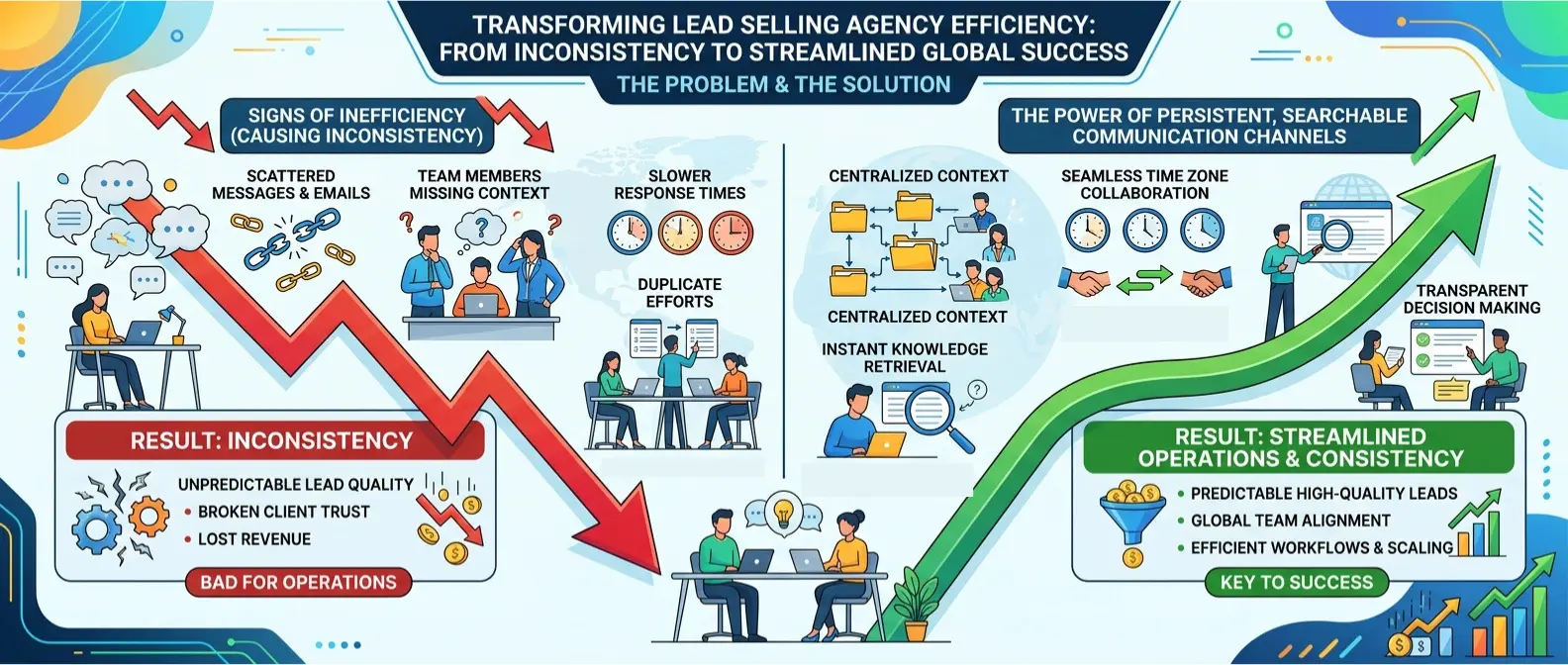
Persistent, searchable communication channels allow global teams to maintain context across time zones.
Choose the Right Asynchronous Communication Tool
Asynchronous communication tools with some level of formality are better than using regular messengers like Whatsapp and Messages. Use formal messaging tools like Slack or something similar because:
- Keep your agency communications on a unique platform to maintain hygiene
- Use the innate abilities formal messaging applications provide to simplify communication across your teams - all these tools have some powerful features ranging from meeting note takers to conversation searching and summarizing features.
- Tools like Slack also enable this by centralizing communication into persistent channels rather than private conversations or meetings that disappear once they end.
When communication is persistent, the team rely on records.
Searchability of Communication Matters More Than Speed
In asynchronous teams, the ability to find context matters more than the ability to respond instantly. Searchable communication allows team members to:
- Understand past decisions
- See why something was done a certain way
- Avoid repeating resolved discussions
- Onboard faster without shadowing
Tools like Clickup are perfect to keep track of all that is happening as it happens. Speed without context creates mistakes.
Keep Most Communications in Written
Written communication forces clarity.
When updates, decisions, and instructions are written:
- Ambiguity decreases
- Ownership becomes visible
- Assumptions are exposed early
This is impossible with verbal-only or meeting-heavy communication. So don’t try to keep it all in the air. Please.
Fewer Meetings, Higher Output
Meetings do not scale across time zones.
Every meeting excludes someone. Every rescheduled meeting delays decisions. Over time, meetings become a tax on execution rather than a tool for alignment. Reducing meetings forces teams to:
- Document decisions
- Prepare clearer updates
- Think through problems before escalating
Meetings should exist to resolve complexity. Nothing else. International teams that rely on meetings eventually centralize power unintentionally. Teams that rely on documentation distribute it.
Channel Structure Prevents Noise
Clear channel separation ensures:
- Sales updates are not mixed with ops issues
- Buyer disputes do not get buried
- Alerts are distinguishable from discussion
Once again, Slack is beautifully designed to assist with greetings structured channels with the ability to include the right people in each channel. Noise is the enemy of async systems. Structure keeps signal intact.
Communication as an Operational Safety Net
In lead businesses, things go wrong regularly:
- Buyers complain
- Leads dispute
- Payments fail
- Campaigns dip unexpectedly
Communication is the lifeblood of agencies.
When communication is structured and persistent, issues are easier to diagnose and resolve because the timeline is visible. When communication is fragmented, teams react emotionally instead of analytically. International operations need calm systems, not heroic individuals.
The Bottom Line
International teams do not need more communication.
They need better-designed communication.
Asynchronous, written, searchable systems:
- Reduce burnout
- Preserve context
- Increase accountability
- Enable scale across time zones
- GET THINGS DONE
When communication is treated as infrastructure, teams operate smoothly, even when no one is online at the same time. In global lead businesses, alignment is achieved through strong communications.
Read Next: Complete Guide on How to Start a Lead Generation Agency and Sell Leads Globally
Set up Slacks and get your team organized across time zones.
LeadSwitchboard makes it all work together. One platform for everything.