Project Management & Tracking Systems for Global Lead Agencies
Execution Infrastructure
Most lead businesses fail because insight never turns into repeatable action. In international operations, this gap widens quickly. Time zones, distributed teams, and constant experimentation create complexity that cannot be managed informally.
Project management tools are not a productivity layer.
Such tools are execution infrastructure.
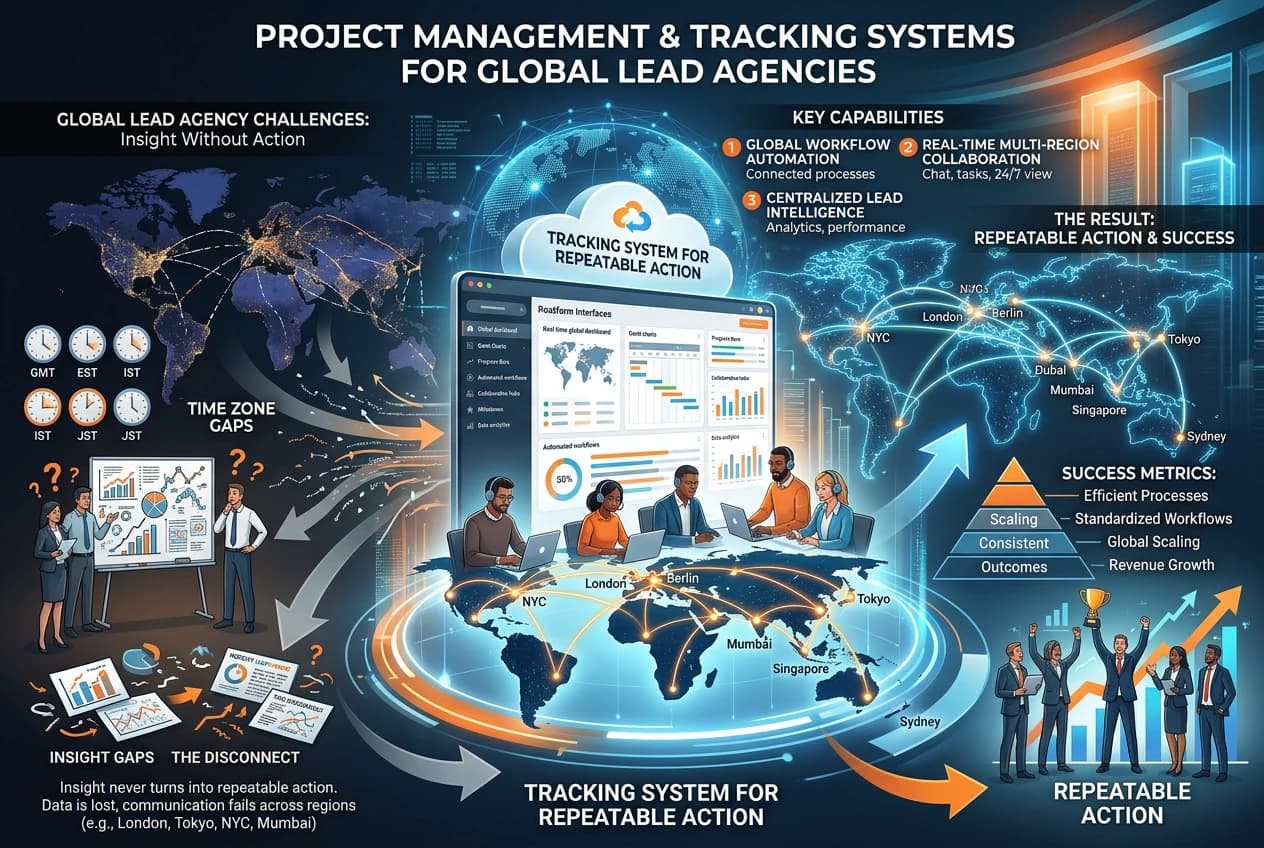
Why Execution Breaks at Scale
In the early stages, founders hold everything in their heads. Decisions are made quickly. Changes happen instantly. This works until it doesn’t.
As teams grow and operations span time zones, this informal approach breaks down. Key challenges emerge:
- Context lost between shifts - for big agencies operating in shifts, however, small teams may also work asynchronously.
- Urgent issues waiting hours for response - delays compound when critical information isn't readily available.
- Lack of clear ownership - tasks fall through the cracks without explicit assignment and tracking.
- Inconsistent processes - without documented workflows, quality and efficiency fluctuate.
When these happen - your agency is running inefficient. The result is inconsistency. And inconsistency is bad for a lead selling agency’s operations. This fragility becomes a liability.
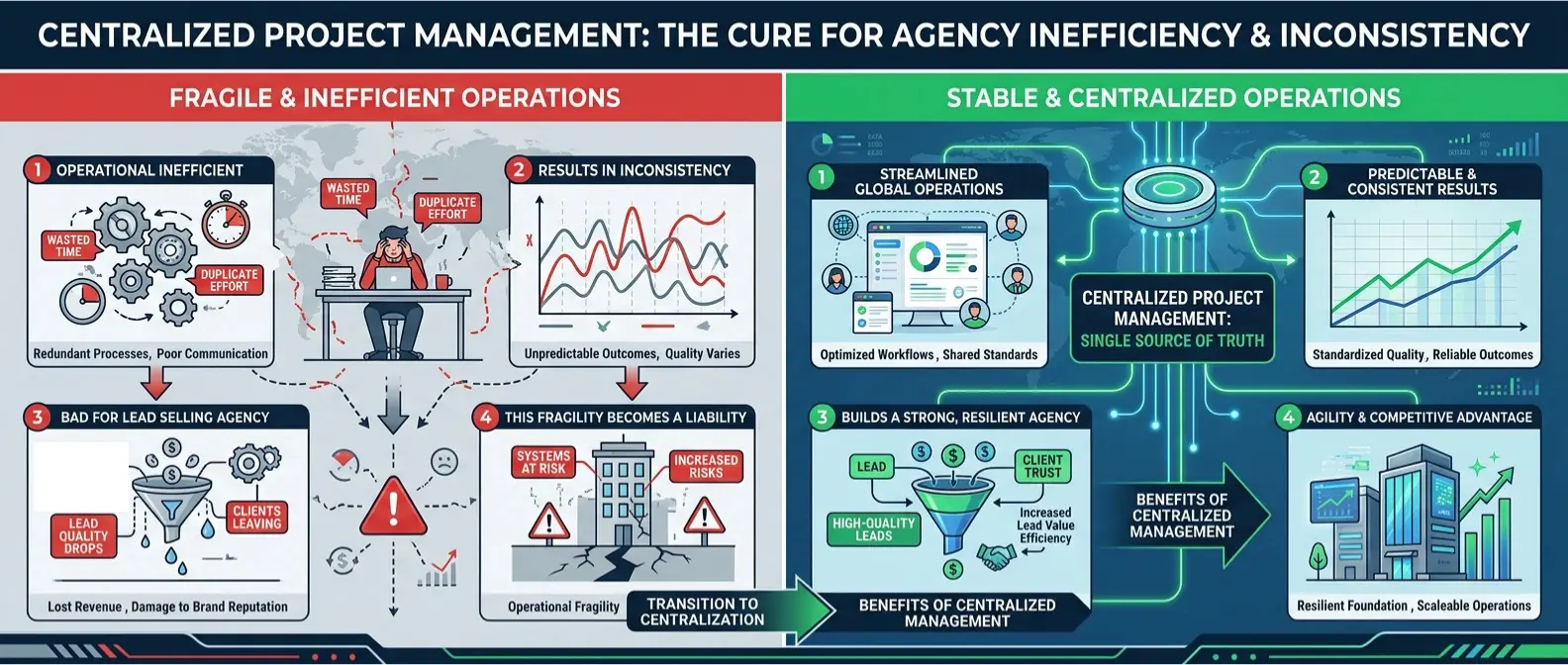
Centralized project management provides a single source of truth for complex global operations.
Centralization Is the First Step to Control
A centralized project management system creates a single source of truth.
Tools like ClickUp allow teams to manage:
- Campaign launches
- Buyer onboarding
- Funnel experiments
- Internal improvements
- Documentation
When work lives in one place, visibility increases. Leadership can see what is in motion, what is blocked, and what is complete - without chasing updates across time zones. Centralization reduces noise and prevents parallel work that wastes time.
Standardized Processes Reduce Cognitive Load
Standardization is not about rigidity. It is about reducing decision fatigue.
When processes are documented and repeatable:
- Teams don’t reinvent workflows
- New hires ramp faster
- Mistakes decrease
- Output becomes consistent
In lead businesses, many actions repeat:
- Launching a new market
- Onboarding a buyer
- Adjusting pricing rules
- Rolling out a feature
Documented workflows turn these from complex tasks into checklists. This frees cognitive energy for optimization rather than coordination.
Repeatability Enables Scale
Repeatability is the foundation of scale.
If a process cannot be repeated reliably, it cannot be scaled. Informal execution depends on context, memory, and availability. Systems-based execution depends on documentation and enforcement.
Project management tools allow teams to templatize:
- Launch plans
- Experiment frameworks
- Incident response procedures
- Dispute workflows
These templates act as guardrails. They prevent chaos.
Visibility Drives Accountability
When work is visible, accountability follows naturally.
Clear task ownership answers three critical questions:
- Who is responsible?
- What is the expected outcome?
- When is it due?
In international teams, this clarity is essential. Without it, work drifts between time zones with no clear owner. Delays go unnoticed until they compound.
Project management systems make accountability explicit without confrontation.
Documentation Is a Force Multiplier
Documentation is often treated as optional. In reality, it is a force multiplier.
When decisions, processes, and outcomes are documented:
- Knowledge survives turnover
- Teams learn from past experiments
- Mistakes are not repeated
- Progress compounds
International lead businesses generate constant learning. Without documentation, that learning is lost. With documentation, it becomes institutional knowledge.
Documentation is not busywork.
It is memory for the organization.
Execution Without Systems Is Guesswork
Many teams believe they are executing when they are actually reacting.
Without structured execution systems:
- Priorities shift constantly
- Urgency overrides importance
- Experiments lack conclusions
- Teams operate in cycles of fire-fighting
Project management systems create intentionality. Work is planned, executed, reviewed, and refined.
This turns execution from guesswork into process.
Systems Reduce Founder Dependency
One of the hidden risks in growing lead businesses is founder dependency.
When founders are the bottleneck for:
- Decisions
- Context
- Approval
Documented workflows and visible execution systems distribute knowledge and authority. Teams operate independently within defined boundaries.
This is how businesses scale without burning out leadership.
The Bottom Line
Execution is not about effort. It is about structure.
Project management and execution systems:
- Turn ideas into outcomes
- Reduce chaos
- Preserve knowledge
- Enable scale across time zones
Without systems, growth depends on heroics. With systems, growth becomes predictable.
In international lead businesses, execution must outlive individuals. That only happens when it is designed as infrastructure - not left to chance.
Read Next: Complete Guide on How to Start a Lead Generation Agency and Sell Leads Globally
Start building your execution infrastructure today.
LeadSwitchboard makes it all work together. One platform for everything.